
Flagging tape is a simple way to make important locations easier to identify in the field. Surveyors, utility crews, contractors, landscapers, foresters, and other professionals use brightly colored flagging to mark everything from survey points and boundaries to work areas and underground utilities.
But what do flagging tape colors actually mean?
The answer depends on the application. For temporary underground facility marking, the American Public Works Association (APWA) provides a standardized Uniform Color Code. In surveying, construction, forestry, landscaping, and other applications, colors may be used differently based on the project or crew.
Quick Guide: What Do APWA Marking Colors Mean?
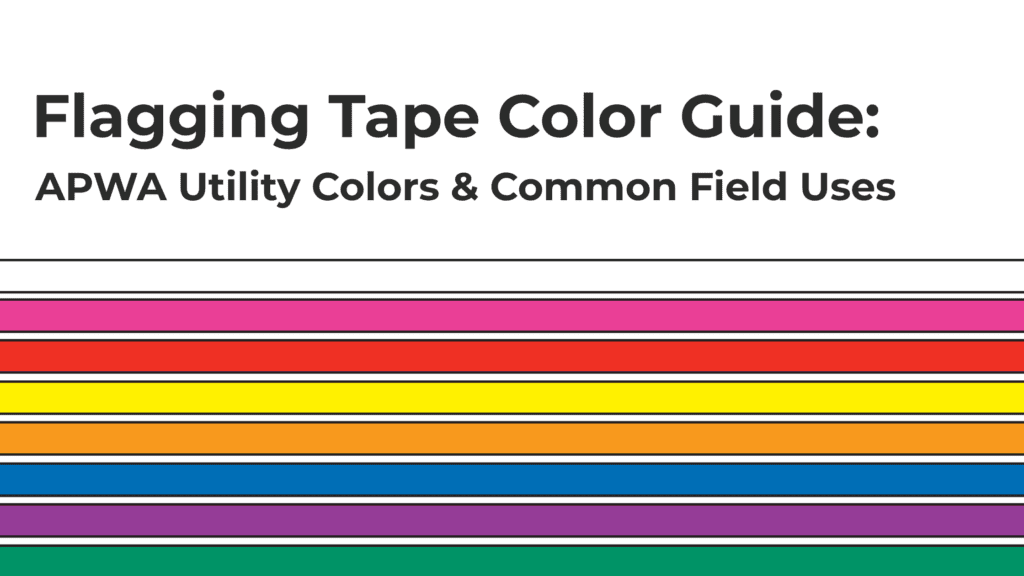
For temporary underground facility marking, the APWA Uniform Color Code identifies the following colors:
| Color | APWA Designation |
|---|---|
| White | Proposed Excavation |
| Pink | Temporary Survey Markings |
| Red | Electric Power Lines, Cables, Conduit and Lighting Cables |
| Yellow | Gas, Oil, Steam, Petroleum or Gaseous Materials |
| Orange | Communication, Alarm or Signal Lines, Cables or Conduit |
| Blue | Potable Water |
| Purple | Reclaimed Water, Irrigation and Slurry Lines |
| Green | Sewers and Drain Lines |
These colors help create a consistent visual language for people working around underground facilities. APWA encourages public agencies, utilities, contractors, manufacturers, and others involved in excavation to adopt the Uniform Color Code.
How Are APWA Colors Used in the Field?
The APWA system is broader than flagging tape alone.
Its guidelines call for color-coded surface marks, such as paint or chalk, to indicate the location or route of active and out-of-service buried lines. For increased visibility, vertical markers such as stakes or flags should supplement those surface markings.
APWA also specifies white markings for the location, route, or boundary of a proposed excavation and pink for temporary survey markings.
Most importantly, colored markings are not a substitute for the appropriate damage-prevention process. APWA’s guidance states that the One-Call damage prevention system should be contacted before excavation.
Do Flagging Tape Colors Always Mean the Same Thing?
No. This is an important distinction.
The APWA Uniform Color Code applies to temporary marking and identification associated with underground facilities. Flagging tape is also widely used for surveying, construction, forestry, landscaping, environmental marking, boundaries, trails, and general jobsite organization.
In those applications, a project’s color system may differ from the APWA code. Crews should establish and communicate their marking conventions rather than assuming a color always carries the same meaning.
Common Uses for Flagging Tape
Surveying
High-visibility flagging can make survey points, stakes, boundaries, and other reference locations easier to identify in the field. Pink is specifically designated by APWA for temporary survey markings when working within its Uniform Color Code.
Construction
Contractors can use flagging to identify layout points, work areas, boundaries, materials, and other locations that need to remain visible as work progresses.
Utility Marking
Color-coded flagging can provide additional visibility around utility identification and marking. When working with underground facilities, crews should follow applicable requirements and the established APWA color system rather than creating their own color meanings.
Forestry, Landscaping & Environmental Marking
Flagging tape can also identify trees, trails, property areas, landscaping locations, wetlands, environmental boundaries, and other outdoor reference points. MMD carries flagging specifically suited to these types of field applications.
How to Choose the Right Flagging Tape
Color is only part of the decision. Visibility, temperature, durability, material, and the environment where the flagging will be used can all matter.
For high visibility: Bright standard and fluorescent colors can help crews quickly identify marked locations.
For cold-weather work: Presco Arctic Roll Flagging is rated for temperatures down to -40°F and is designed to remain flexible in extreme cold.
For demanding outdoor conditions: Presco Texas Roll Flagging is temperature rated to -20°F and is available in a wide selection of standard and fluorescent colors.
For specialized identification: Striped and patterned flagging can help distinguish specific areas or purposes when a solid color alone is not enough.
For environmentally sensitive applications: Biodegradable flagging is another option available for projects where material selection and environmental impact are considerations.
Flagging Tape vs. Utility Flags vs. Marking Paint
These marking products serve different purposes and can also work together.
Flagging tape is lightweight, highly visible, and easy to tie to stakes, trees, fencing, and other objects.
Utility flags provide an upright marker that is easy to see across a work area and are commonly used for utility locating, surveying, construction, and field marking.
Marking paint creates a visible surface mark directly on the ground or another suitable surface.
For underground facility marking, APWA specifically describes color-coded surface marks supplemented by vertical markers such as stakes or flags to increase visibility.
Frequently Asked Questions About Flagging Tape Colors
What do flagging tape colors mean?
It depends on the application. When colors are being used for temporary underground facility marking, the APWA Uniform Color Code establishes standardized meanings. Flagging used for construction, forestry, landscaping, or other purposes may follow different project-specific conventions.
What color is used for temporary survey markings?
Under the APWA Uniform Color Code, pink identifies temporary survey markings.
What does orange mean for utility marking?
APWA designates orange for communication, alarm or signal lines, cables or conduit.
What does blue mean for utility marking?
APWA designates blue for potable water.
What does red mean for utility marking?
APWA designates red for electric power lines, cables, conduit and lighting cables.
Is flagging tape enough to mark underground utilities?
APWA’s guidance describes color-coded surface marks such as paint or chalk for buried facilities, with stakes or flags used as supplemental vertical markers to increase visibility. The One-Call damage prevention system should also be contacted before excavation.
What flagging tape works in cold weather?
MMD carries Presco Arctic Roll Flagging, which is rated to -40°F, as well as Presco Texas Roll Flagging, which is rated to -20°F.
Find the Right Flagging for the Job
From surveying and construction to utility locating and environmental marking, the right flagging helps crews keep important locations visible and organized.
MMD carries high-visibility flagging tape, striped ribbon, biodegradable flagging, cold-weather options, and other field marking supplies for professional applications. With nationwide shipping and knowledgeable support, we can help you find the right flagging for your next project.